Weeds and their Native lookalikes.
Written by: Chelsea Haley, Sanctuary Ranger
Identifying plants in the Sanctuary can be tricky, especially when some of our native species have invasive lookalikes with very similar features. Because we aim to protect as much native vegetation as possible, it’s important to understand the key differences between these plants and avoid removing natives by mistake.
A number of weeds in the Sanctuary are easily confused with native vines, ferns, grasses or lycophytes. Some of these weeds spread quickly and can smother other plants, while their native counterparts are often slower-growing and play important roles in the forest ecosystem.
This article outlines several of the most commonly misidentified plants in the Sanctuary and the features you can use to tell them apart. If you come across something you think may be a weed but you’re not certain, please leave it in place and send photos to the ecology team for identification before pulling anything out.
Clematis
We have four confirmed species of clematis within the Brook Waimārama Sanctuary, three of which are native, and one is the well-known, much-hated old man’s beard (Clematis vitalba).
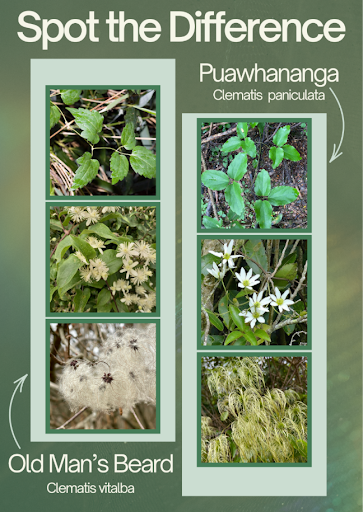
Old man’s beard is a deciduous vine that easily overwhelms and smothers large areas of native bush. The vines are usually thick and woody with strongly ribbed bark along the branches. Thick mature stems can sometimes be flaky.
Old man’s beard, while bearing a resemblance to our native clematis, has many differences, such as thinner leaves in comparison to our native species, which have coriaceous leaves. This means our native species’ leaves are thicker and leathery.
Old man’s beard has five leaflets, very seldom three leaflets. This means that the leaves of old man’s beard almost always grow in groups of five, whereas most of our native’s leaves grow in sets of three and are evergreen.
The flowers of the species are also very distinctive. As most know, Clematis paniculata blooms large, white striking flowers very early in spring, followed by distinctive, fluffy seed heads in early summer. Old man’s beard has small, off-white flowers whose stamens stick out more than the petals. They bloom in late spring to early summer, and the seed heads persist into winter.
Old man’s beard also tends to smother areas. Where you find one, you will find more, and it will root in multiple different points. Native clematis will be rooted to one point and will be sparse in distribution.
These are all characteristics you can apply when looking at a vine you think could be old man’s beard.
Clubmoss and climbing asparagus
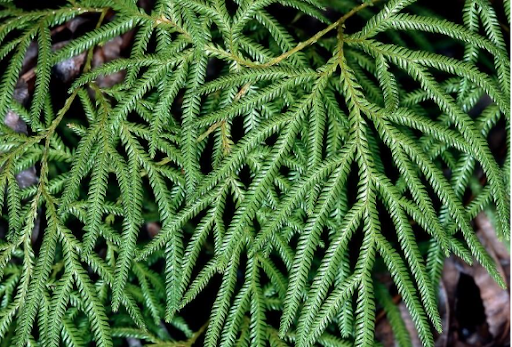
Climbing clubmoss is one of three native lycophytes found in the Sanctuary. These have often been confused in the Sanctuary with the invasive exotic climbing asparagus and been pulled out.
Clubmoss is a beautiful and interesting native lycophyte (flowerless, seedless vascular plant, reproducing via spores but more primitive than ferns). Its climbing habit can make it look like an invasive, as it can colonise large areas of bare ground.
The native clubmoss appears flat and somewhat rigid, apart from its sporophyll (reproductive structure), which becomes more tubular. It also grows at diagonal angles across the ground.
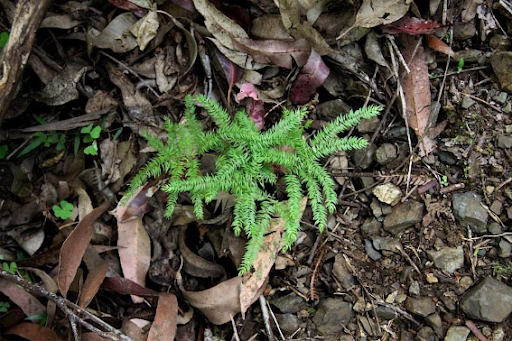
Climbing asparagus, on the other hand, has visible round stems with soft feathery leaves that grow in whorls around the stem. As it is an angiosperm, it reproduces via small white flowers and delicate little orange fruits. It tends to grow straight up and scramble onto nearby plants, with the ability to smother young natives. It is also a lighter green in colour and has a feathery, light appearance in dense bush.
(photo labels: climbing asparagus, native clubmoss, climbing asparagus)
Native club moss
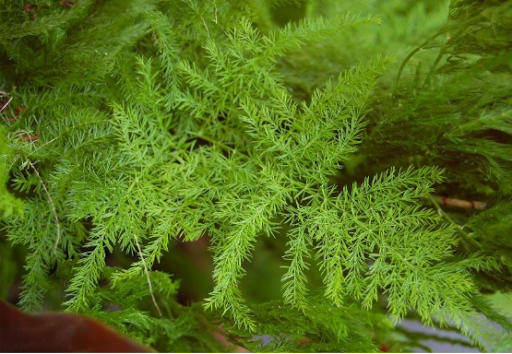
Climbing asparagus
Cretan brake can be mistaken for a native fern
Cretan brake is an invasive fern that has taken over a large area across from Ferny Flats / the far end of Old Batch Track. This fern creeps along the ground via rhizomes, forming colonies where the dead fronds can smother the ground and make it hard for anything else to grow.
On occasion, these ferns will pop up in the wider Sanctuary too, and if you know what you are looking for it would be good to rip them out. However, these ferns can be easily mistaken for our native spleenwort to the untrained eye, so it is best to know what you are looking for.
If you have suspicions but are not certain on species, take some clear photos of both the fronds and the sori (the spores located on the underside of the fronds) and bring them to the Visitor Centre.
(photo: Cretan brake)
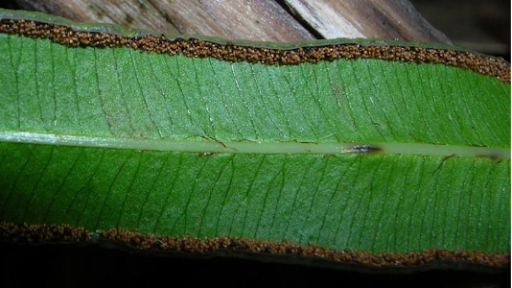
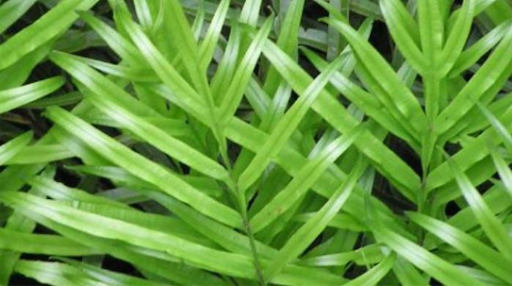
Cretan brake
Pampas, toetoe and Gahnia
You are walking in the Sanctuary, enjoying the vast beech forest and listening to the chatter of kākāriki, the sharp peeps of tītipounamu and the loud, otherworldly twangs of korimako. Suddenly you are face to face with a large grass, almost taller than you are. You think to yourself, this might be that horrible pampas grass, a weed that has taken hold of some areas of Nelson.
Before you decide to take a silky to this giant grass, it’s important you know a few identifying features to tell it apart from the beautiful native toetoe and cutty sedge we have in the Sanctuary.
First of all, Gahnia is a common large grass-like sedge that grows within the Sanctuary and is very distinctive from pampas and toetoe. It has drooping seed heads with seeds that grow on stringy structures with leathery black sheaths. These differ from the characteristic fluffy tufts of the pampas and toetoe. The seeds are large, brown and hard. The plants have long cutty leaves and are a dark glossy green.
The difference between toetoe (Austroderia richardii) and pampas grass (Cortaderia selloana) is a bit more subtle.
A lovely example of our native toetoe is just past Kākāriki Hatch on the fenceline. Toetoe has a much more elegant form, growing much less densely than pampas. It is also shorter, only growing to about 3 metres. Other identifying features of toetoe are the several obvious leaf veins either side of the central midrib. The dead leaves also do not curl at the base. The flowers and stems both droop downward. The flowers are golden to cream in colour and the seeds cascade in a drooping fashion. Toetoe flowers mid spring to early summer.
Pampas is a much larger, dense-growing thick grass reaching a height of up to 5 metres when mature. Pampas leaves have one prominent midrib and very sharp edges. They often have a large mat of dead leaves that curl up and look like wood shavings at the base. The flowers and stems stick straight up and are creamy to pink, sometimes purple, in colour with dense white fluffy seed. They start flowering in autumn. If you bend the leaves they snap, while toetoe and Gahnia are tough.
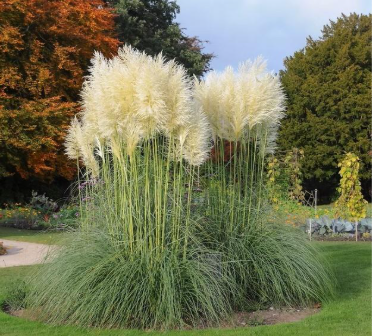
Pampas
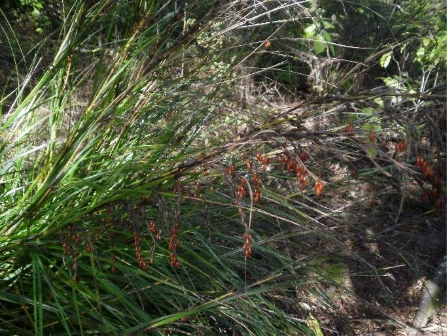
Gahnia
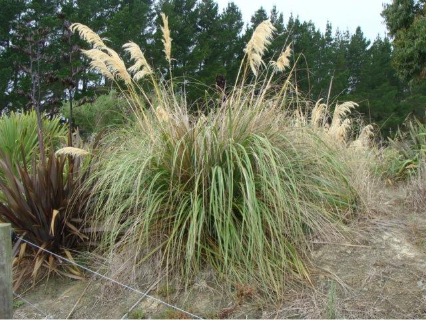
Toetoe
Native sedges
We have a number of native sedges growing alongside tracks. Colloquially known as “bastard grass”, these plants can be slightly unpleasant to brush up against, especially to those among us with hairy legs. They have fibrous leaves with sharp cutty margins and hooked seeds. They are not weeds – they are a natural part of the environment and should be left alone.
Exotic grass by comparison is light green, sometimes slightly hairy, and not as fibrous.
As an ecological restoration project we aim to protect as many native plants as possible, as no matter how common they are, they still have important ecological context.
If you come across something you think is a weed in the Sanctuary but are unsure, please leave it and send photos and the location to chelsea.haley@brooksanctuary.org.nz or henry.hart@brooksanctuary.org.nz for identification and do not pull it out.
Alternatively, if you are interested in learning more about weeds and how to manage them, join our Sanctuary weeding team, who go out every Tuesday into the lower parts of the Sanctuary.