The Fish Ladder Project
Written by: Akira and Dave Garnett
I have been volunteering at The Brook Waimārama Sanctuary in various roles over the years, but for the past ten years or so, my focus has increasingly been on fish and aquatic life. My first role in this area was cleaning the aquariums in the visitor centre, which had become almost completely covered in algae, making it difficult to see the creatures inside. Aquariums are like small ecosystems. Maintaining a balanced environment that prevents excessive algae growth—a sign of nutrient enrichment—is not easy, and the early days involved a lot of trial and error. Today, with systems to maintain stable water temperatures, UV sterilisation, and careful management of feeding frequency and quantity, we can offer visitors a relatively stable and healthy environment to observe.
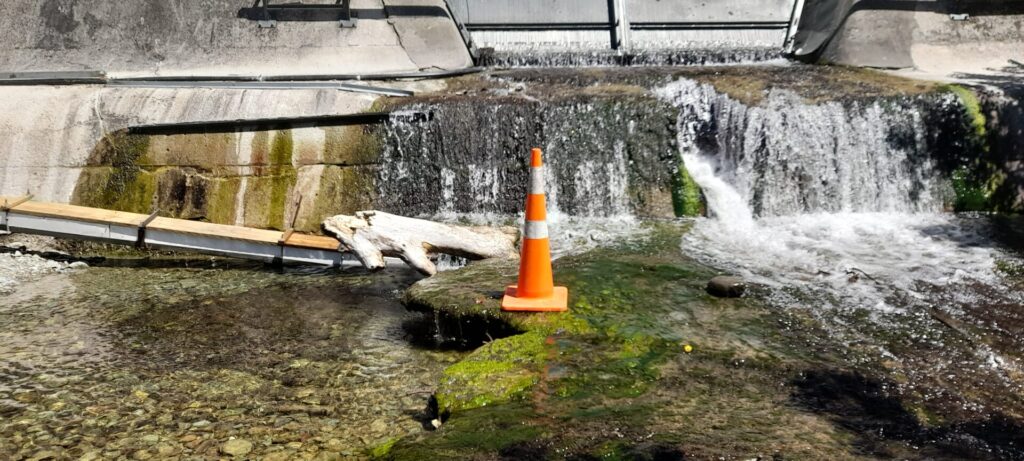
In parallel with this work, around 2018, I began monitoring and studying the fish ladder installed in Brook Stream. The Sanctuary’s boundary along the stream is one of the most vulnerable points for pest intrusion. A swinging floodgate covered with pest-proof mesh has been installed at the dam where the stream exits the Sanctuary to prevent pests from entering. However, this structure also hinders migratory fish. To help fish move upstream past the gate, a fish ladder and traps were installed.
After five to six years of the fish ladder being in place, I noticed that its effectiveness had never really been reviewed. Was it truly helping fish migrate upstream? To answer this, I spent the first three years collecting baseline data: the species, numbers, and sizes of fish caught in the traps. The results showed that while Crayfish (Kōura) were caught in significant numbers, very few other fish species were captured. Academic papers often report that many fish can climb wet surfaces, but in practice, the ability to climb does not always translate into the willingness or preference to do so in the wild. Ideally, the composition and density of fish species upstream and downstream of the floodgate should be similar. In reality, this was not the case. The structure of the floodgate—or the concrete dam itself—clearly limited fish migration.
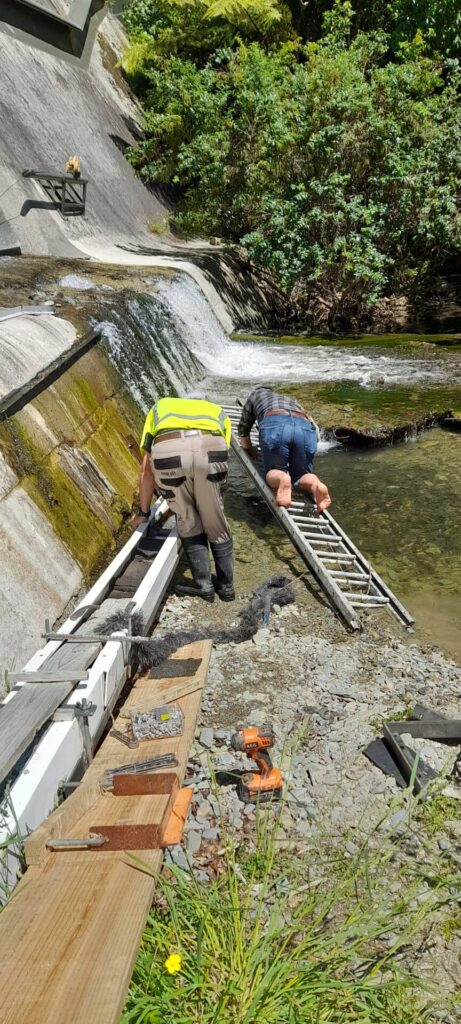
Given these findings, I began a major redesign of the fish ladder around 2022. To understand what was needed, I first looked at NCC reports to see which fish species were likely to live in Brook Stream within the Sanctuary, and reviewed past studies to get a sense of how well they could swim. Based on this information, I worked out suitable water depths and flow speeds for the ladder. I then adjusted the number and shape of the baffles to slow the water down, and shaped the entrance of the ladder into an L-shape so that it followed the natural direction of the stream, taking advantage of fish rheotaxis—their natural instinct to swim against the current—to encourage fish to enter and move upstream.
However, the real challenges came after construction. Unexpected floods destroyed and washed away the new structures twice. Balancing three key requirements—an ideal design for the fish, flood resilience, and a limited budget—required immense effort from the Asset Team, particularly Dave Garnett and John Ayers, who supported me both technically and morally throughout the project.
After much trial and error, we finally activated the latest version of the fish ladder on 5 December this year. Just one week later, on 12 December, a Koaro (a fish species in the Galaxiidae family) was observed in the trap. This species had rarely been captured before, marking the first time we had achieved a long-sought goal.
Looking ahead, it will be important to continue evaluating the system’s effectiveness and its resilience to floods, making improvements where necessary. Through these efforts, I hope to establish more fish species within the Sanctuary and create a richer, more diverse, and healthy aquatic environment.